Architectural ‘Descendants’
How does one articulate into words. . . our feelings, our mindset, our emotions regarding the man-made world? (Is Older Architecture better?) Life has such deep meaning that it becomes difficult to find within the English vocabulary adequate means to describe the state of our eternal soul. The in-depth effort to discover those “words” is a large part of the journey of life. As architects, each project brings its own unique challenges and distinctive history. Our design challenge is to transform the “story” into steel, brick and stone.
An architect’s unique experience, expertise and process allows us to blend history & preservation with safety & sustainability. We use today’s technology to capture the past, literally to faithfully and accurately re-create the subtlety and nuance of antiquarian buildings in every detail. Case in point – this article is a brief overview of a unique 2013-2015 project whereby D. Tracy Ward, Architect aided in the effort to celebrate the life of a great Mississippi author – Eudora Welty – by featuring two examples of great Mississippi architecture – the New Capitol and Windsor Ruins.

Mississippi Capitol sculptural relief / built 1903 / Library of Congress photograph 1983
Saving the extraordinary beauty and craft of the past is worthy of our utmost efforts. (we’ll talk elsewhere about training a new generation of lost craftsmen!) These are not just reproductions, these are kin, descendants, if you will.
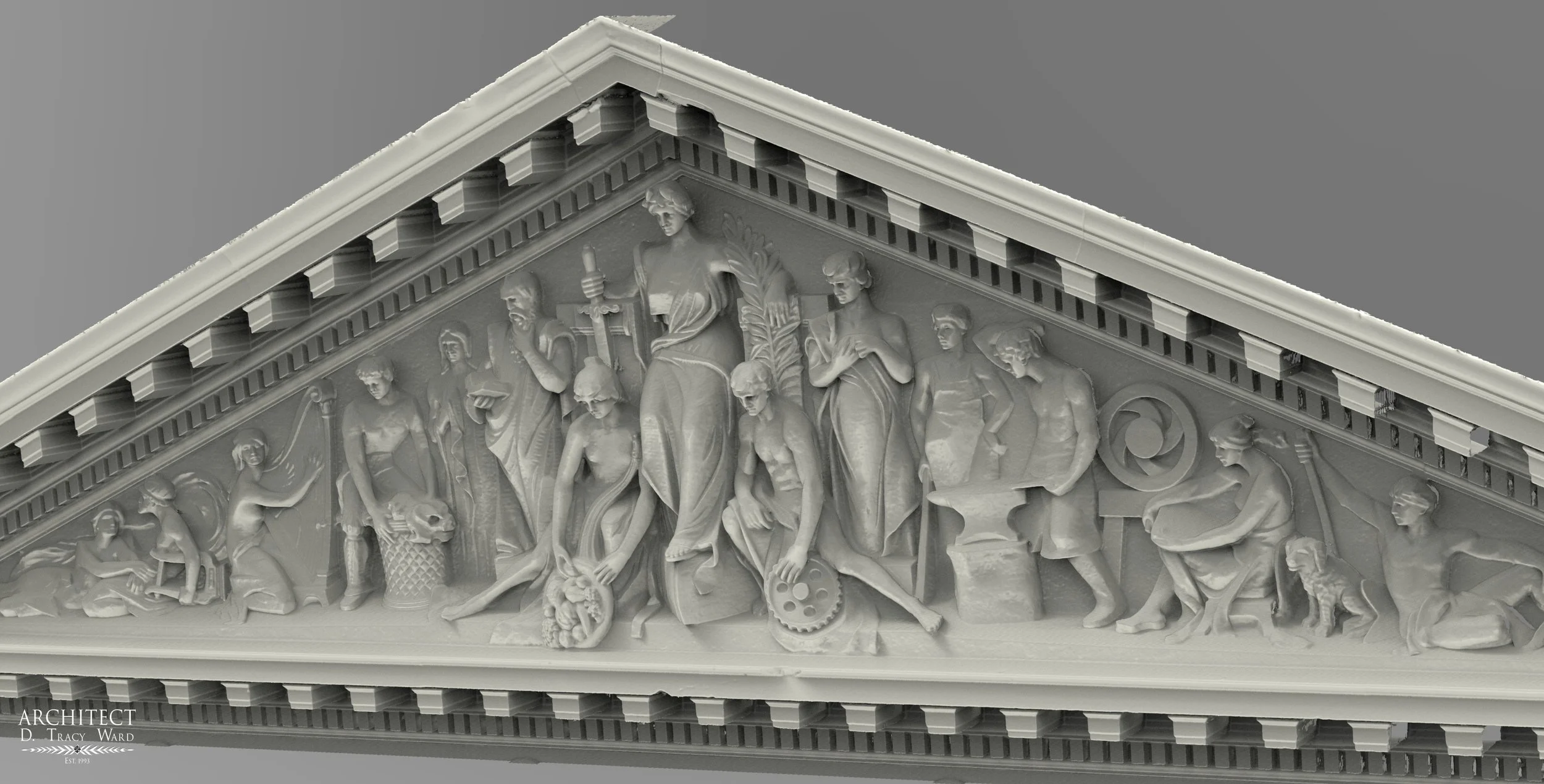
Computer image derived from the laser scanning process of the original
A 2015 exhibition at the Mississippi Museum of Art celebrated the life and work of Mississippi’s Pulitzer Prize winning author – Eudora Welty (1909-2001), who grew up in Jackson, Mississippi playing inside and around the Beaux-Arts style Capitol building where her father worked occasionally. The 1903 building attained in 2017 the prestigious status of ‘National Historic Landmark’.
Welty famously wrote about and photographed the fascinating and surreal place known as Windsor Ruins in the Mississippi River bottom wilderness of Southwest Mississippi . . . a place that, today, transmits one back in time and allows the modern student of history a chance to physically re-experience the past. In a way the quiet wooded, rural atmosphere actually absorbs you into another era far from the present impatient world of endless stress.
“Winding through this land unwarned, rounding to a valley, you will come on a startling thing. Set back in an old gray field, with horses grazing like small fairy animals beside it, is a vast ruin—twenty-two Corinthian columns in an empty oblong and an L. Almost seeming to float like lace, bits of wrought-iron balcony connect them here and there. Live cedar trees are growing from the iron black acanthus leaves, high in the empty air. This is the ruin of Windsor, long since burned. It used to have five stories and an observation tower — Mark Twain used the tower as a sight when he was pilot on the river.” (Eudora Welty – SOME NOTES ON RIVER COUNTRY 1944)
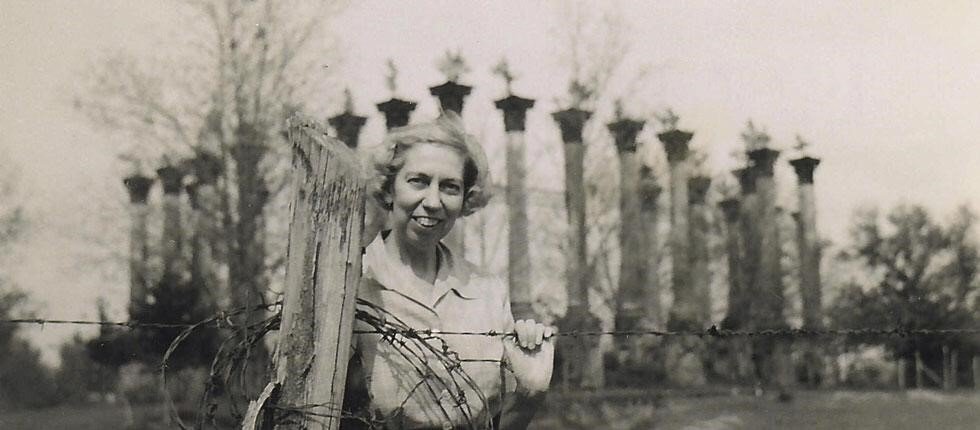
Eudora Welty (1909-2001) at Windsor ca. 1940’s
Long ago the impressive Greek Revival mansion was the centerpiece of a working antebellum plantation, perhaps the largest in Mississippi. All that remains today are its 43 foot tall columns. It’s these monumental and imposing classical Corinthian columns that we electronically scanned and then handcrafted reproductions as the focal points on the exterior lawn of the Museum of Art.
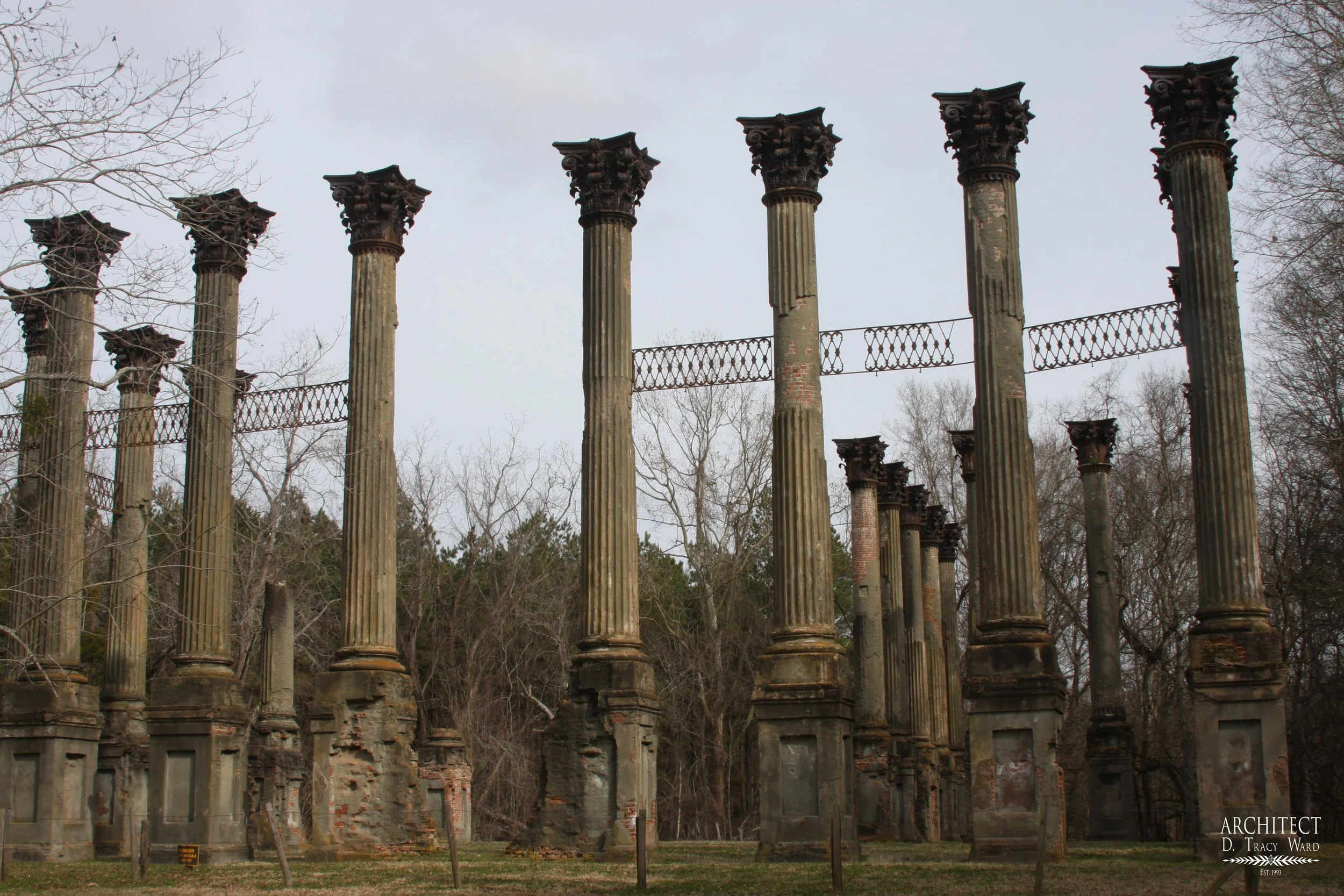
02/26/2014 we scanned the columns and the site area using 3d technology – photo DTWard
RECORDING & DOCUMENTATION PROCESS:
Any device that measures the physical world using lasers, lights or x-rays and generates dense point clouds or polygon meshes can be considered a 3D scanner. They have inherited many names, including 3D digitizers, laser scanners, white light scanners, industrial CT, LIDAR (Light Detection and Ranging), and others. The common uniting factor of all these devices is that they capture the geometry of physical objects with hundreds of thousands or millions of measurements. The actual scanning exercise can be rather time consuming and uninteresting – the scanner makes not a sound as the remote computer(s) slowly collects the almost immeasurable quantity of data.
Late in February of 2014, our team gathered the equipment necessary to scan those 150+ year old stucco-covered brick columns still standing quietly many miles away from any substantial civilized development. The day was unusually cold and blustery for southern Mississippi, and for most of our time we were the only visitors to the state-owned property. In fact, we worried about the ever-worsening weather to the extent that the rented mechanical lift might topple in the abnormally windy conditions. We strapped in the scanner to the tripod and lifted it up unmanned….limiting the potential danger to the equipment only.
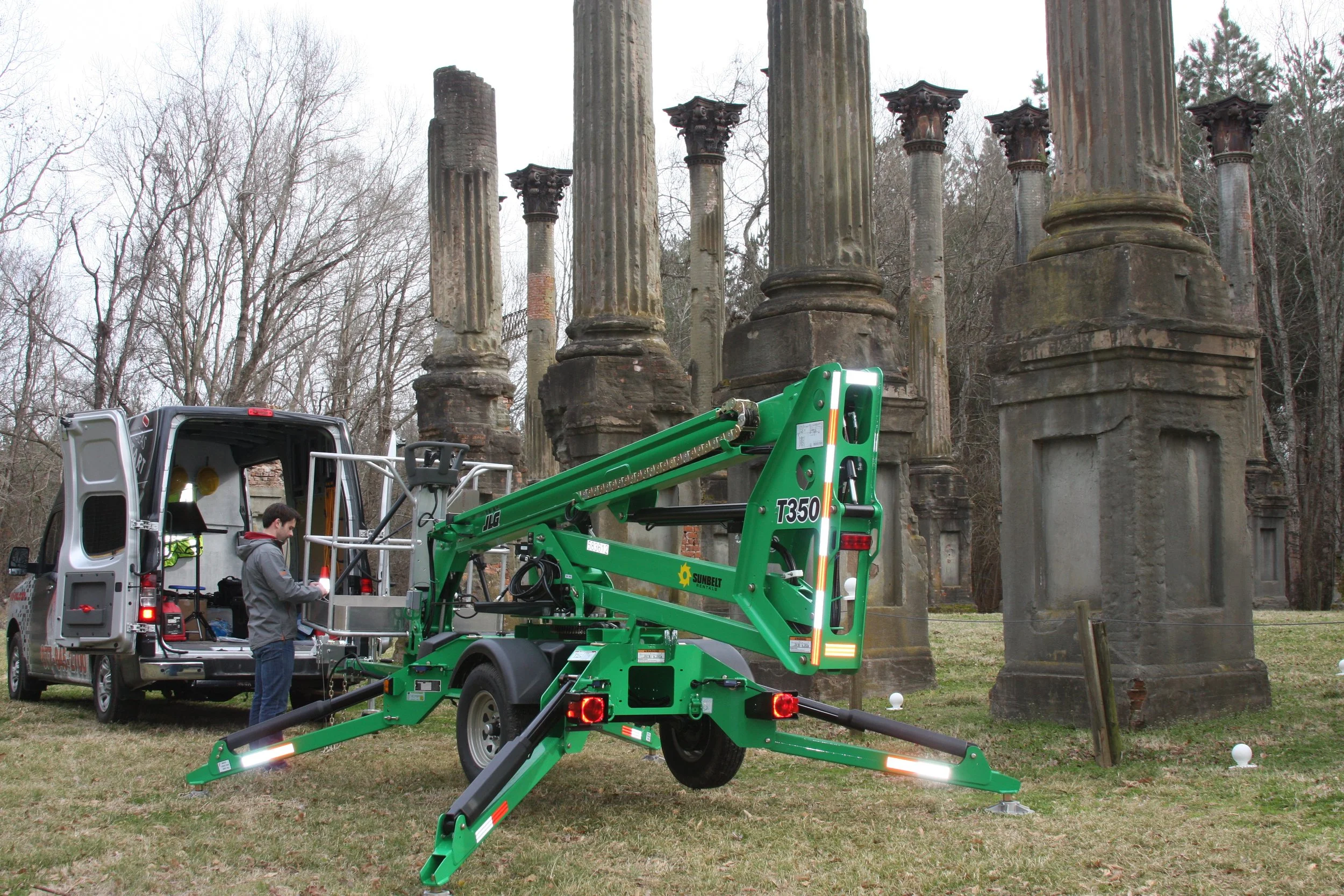
On this day, our engineers utilized the highest resolution & accuracy in a long-range 3D scanner, delivering 1.2 million points per scan in 360 x 270 degrees. Various scanning, modeling and sculpting software packages were incorporated during and after the onsite scanning / data-gathering effort. The field work is only the beginning, as the “cleanup” takes place back in the office where educated interpolation will provide the finishing touches. Often with such an intricate original, the hidden areas may not fully scan, and those zones will be digitally recreated by one our graphic artists having the necessary experience to blend historical (often classical) details with modern computer mechanics. The anticipated end result will guide this aspect of the project, determining the best computer format depending on whether we want to a) create CAD models of entire buildings or b) its detailed parts…or is the file to be used for c) marketing renderings or for d) manufacturing actual reproduced items.
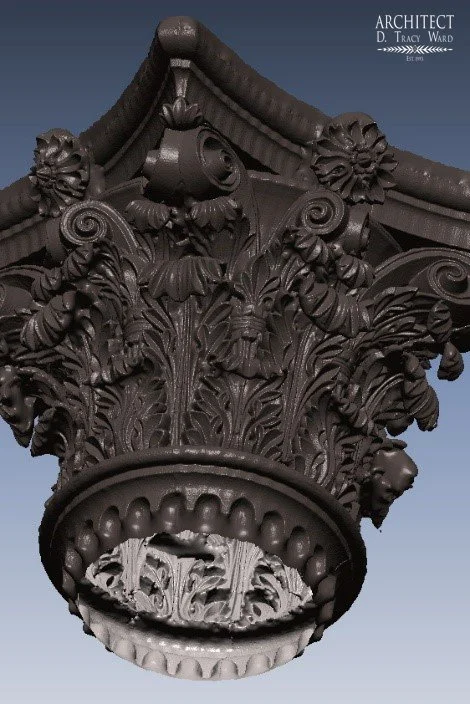
scanned computer image of the cast iron column capitals
REPRODUCTION & MANUFACTURING PROCESS:
FRP (Fiber Reinforced Polymer) composites are very effective in providing high strength components. FRP composites can be designed to provide a vast range of mechanical properties, including tensile, flexural, impact and compressive strengths. The Welty/Windsor replicas were produced as “Composite FRP”. This composite or combination consists of fiber-reinforcement and a polymer matrix. Glass fiber is the reinforcement and polyester resin is the matrix. The glass fiber provides strength and stiffness, and the resin provides shape and protects the fibers. Our structural interior support tubes integrates a process known as “Filament winding”, a common element in the modern aerospace industry. In fact, there are only a few places capable of making our 40’ high tube supports via this filament winding technology – ours were shipped from Virginia.
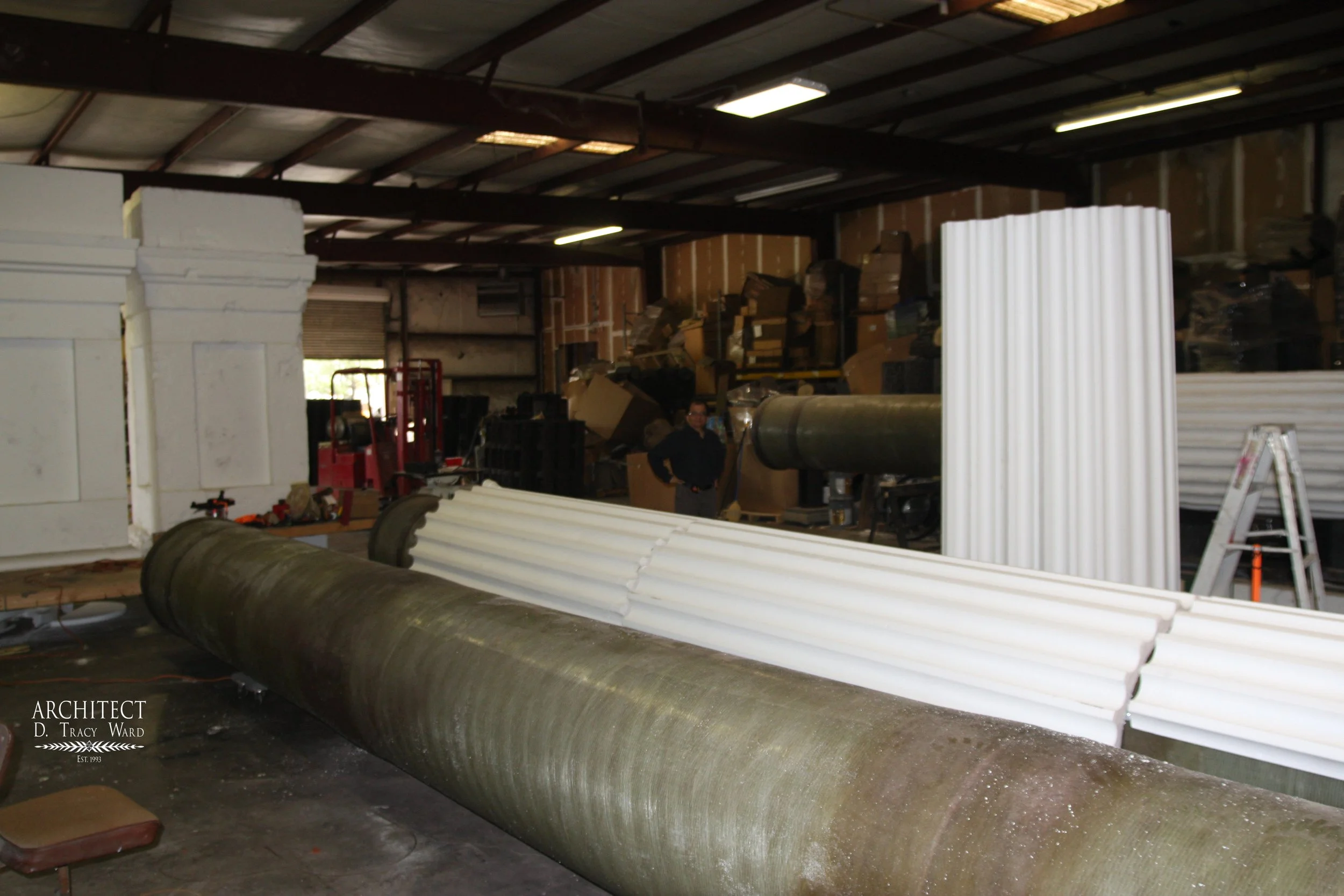
the underlying column strength is provided by glass fiber technology used in aerospace industry
Thermoset vs. Thermoplastics: Composites typically use thermoset resins, which begin as liquid polymers and are converted to solids during the molding process. This process, known as crosslinking, is irreversible. Because of this, these polymers are known as thermosets and cannot be melted and reshaped. However common household plastics such as polyethylene, acrylic, nylon, and polystyrene are known as thermoplastics. These materials may be heated and formed and can be re-heated and returned to the liquid state.
Composites columns are inherently corrosion resistant, high strength, and light weight. The materials can be tailored to meet any performance requirement. This attribute make composites perform differently compared to metals. Designers and engineers have the ability to modify the physical and chemical characteristics by specifying various materials. For example, high glass fiber reinforcement structures produce maximum physical strengths; high resin content structures produce maximum chemical resistance. An engineer can specify the combination of the two materials to create a composites structure resulting in an optimum design. Interestingly, this cannot be done with metals!
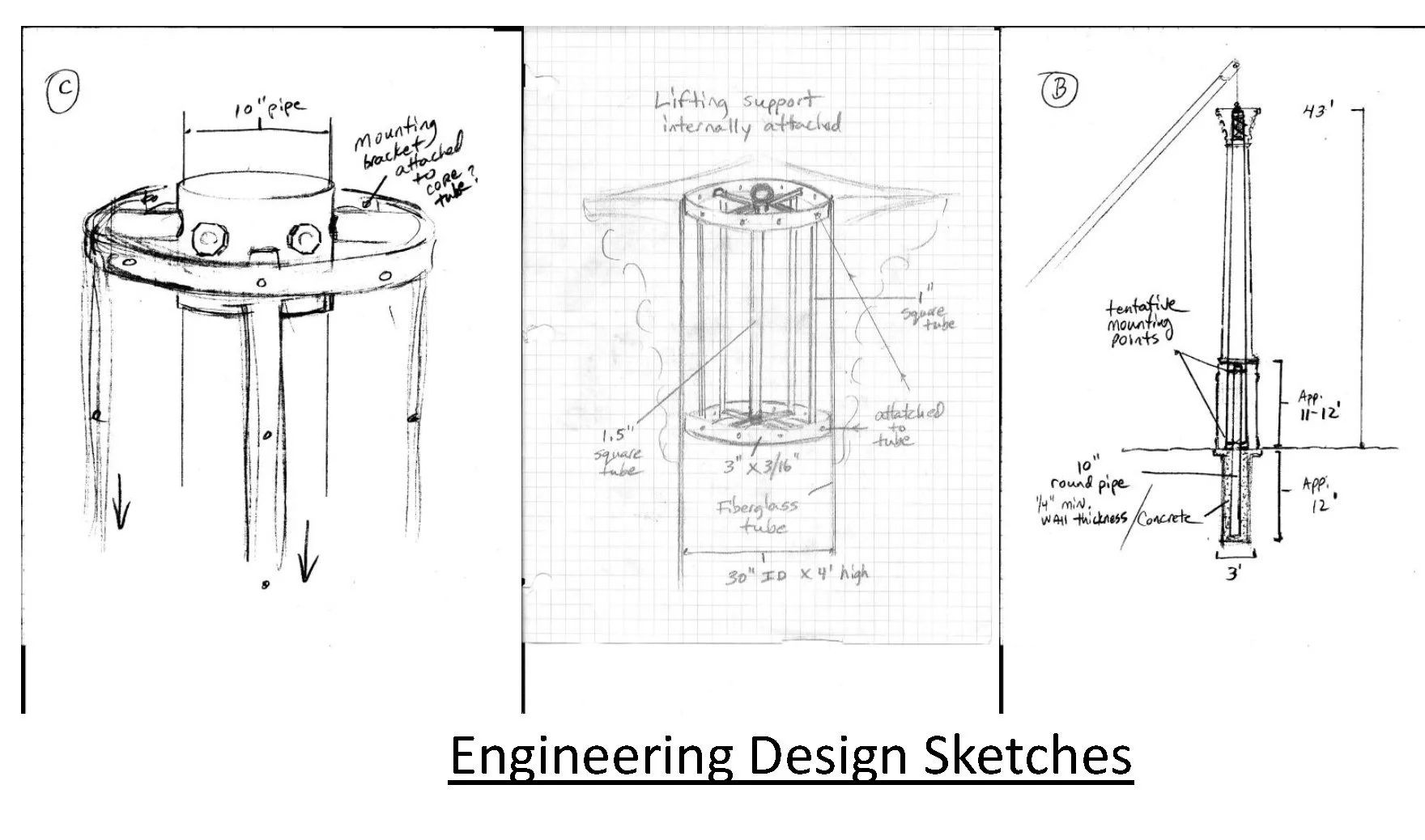
This was an amazing experience to help put together such a remarkable presentation for the Mississippi Museum of Art. There were many individuals that helped it all come together. For instance, we also managed the engineering of the concrete footings and steel interior pipe support columns seen in the images above, as well as deliveries, storage, installation scheduling, etc. This project was already over 3 years ago, and the emerging technologies in 3D scanning and composites manufacturing are evolving quickly… making this type of historic reproduction more affordable, as well as more accurate and authentic. Case in point, last year archaeologists equipped with a LiDAR scanner discovered the ruins of a lost city deep in the Honduran rain forest. Such technology is ushering in a “new age of exploration,” says archaeologist Fredrik Hiebert.
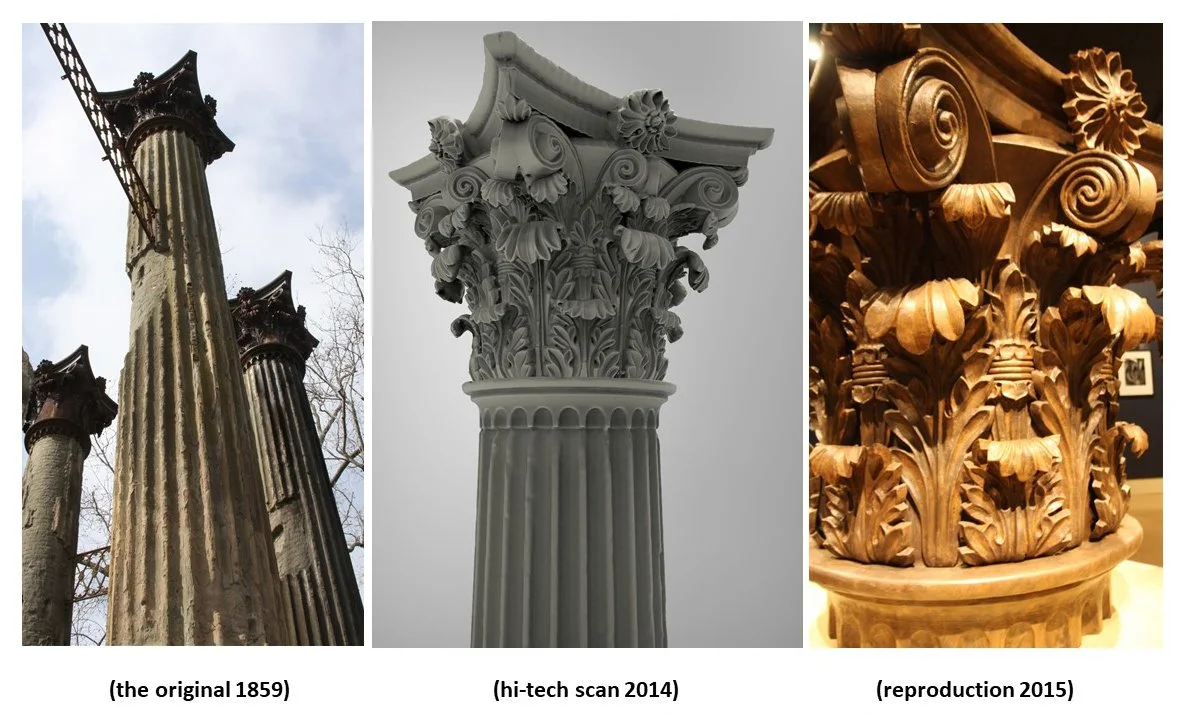
For our team – we’re proud to be leading a new age of preservation & lineage by creating “descendants” that continues our valuable architectural ancestry for future generations!
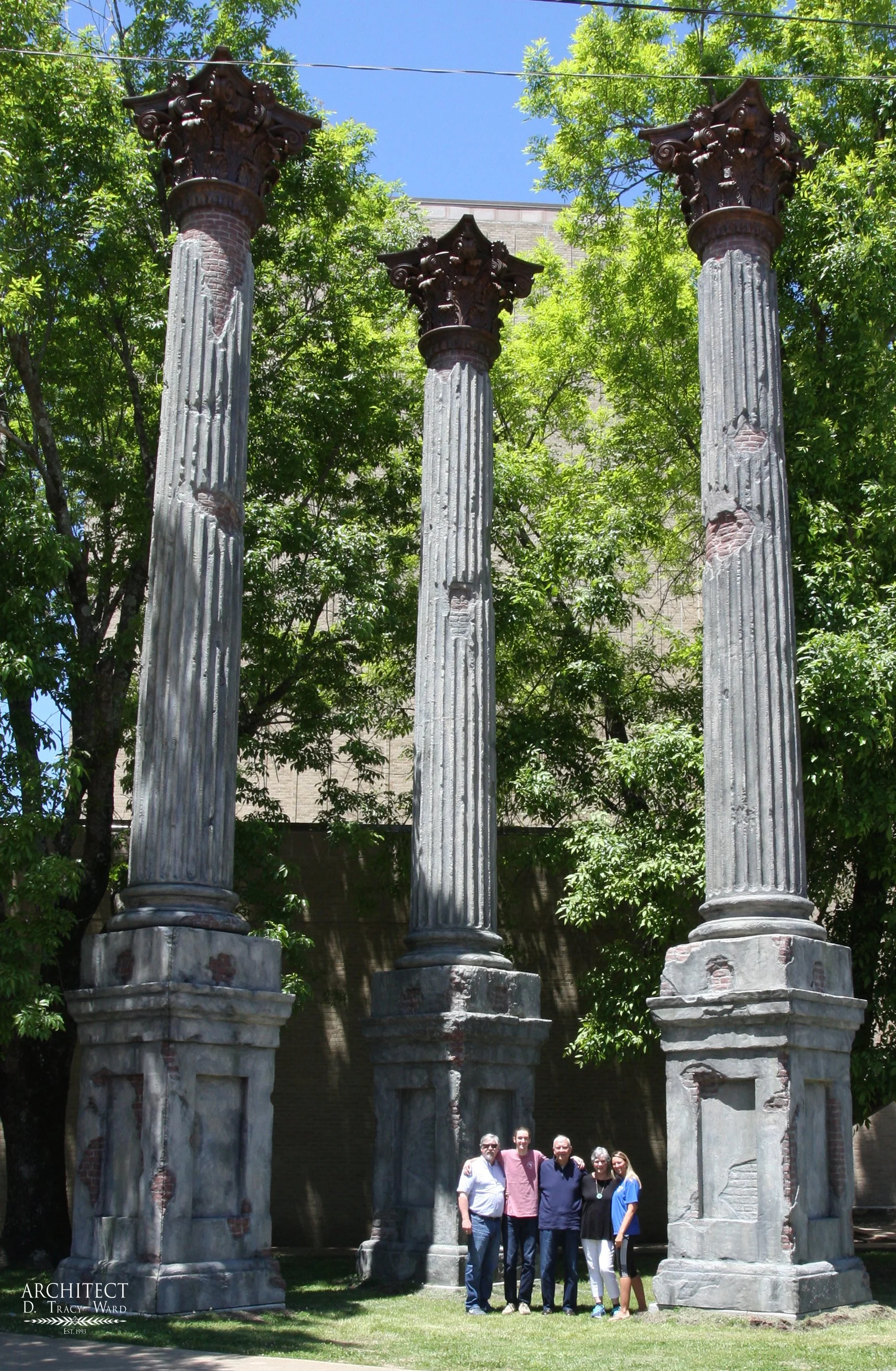
Full scale Windsor replicas on permanent display behind the MS Museum of Art in Jackson
by Heritage Documentation Programs on Sketchfab
D. Tracy Ward, Architect
Originally prepared 2015 – Reedited & Uploaded June 2018 – DTW’s Blog #0031
Our Original Posts, including images when applicable, are copyrighted © 1993-2018 by D. Tracy Ward and Benchmark Design, PC. God bless America! Treasure Liberty always and pass it on! “Architecture aims at Eternity. Architecture has its political Use; publick Buildings being the Ornament of a Country; it establishes a Nation, draws People and Commerce; makes the People love their native Country, which Passion is the Original of all great Actions in a Common-wealth.” [CHRISTOPHER WREN, Parentalia]