The Search for Beauty

What is the definition of beauty?
Is perfection a reality?
Consider for a moment this phrase – beauty is in the eye of the beholder. Do you accept that notion? Or. . . can beauty be something defined/designed in God’s creation and consistently recognized by all of us in nature?
“The classic spirit is the disinterested search for perfection: it is the love of clearness and reasonableness and self-control; it is, above all, the love of permanence and of continuity. It asks of a work of art, not that it shall be novel or effective, but that it shall be fine and noble. It seeks not merely to express individuality or emotion but to express disciplined emotion and individuality retained by law. It strives for the essential rather than the momentary – loves impersonality more than personality, and feels more power in the orderly succession of the hours and seasons than in the violence of earthquake or storm. And it loves to steep itself in tradition. It would have each new work connect itself in the mind of him who sees it with all the noble and lovely works of the past, bringing them to his memory and making their beauty and charm a part of the beauty and charm of the work before him. It does not deny originality and individuality – they are as welcome as inevitable. It does not consider tradition as immutable or set rigid bound to invention. But it desires that each new presentation of truth and beauty shall show us the old truth and the old beauty, seen only from a different angle and colored by a different medium. It wishes to add link by link to the chain of tradition, but it does not wish to break the chain.”
(Kenyon Cox from The Classic Point of View, 1911)
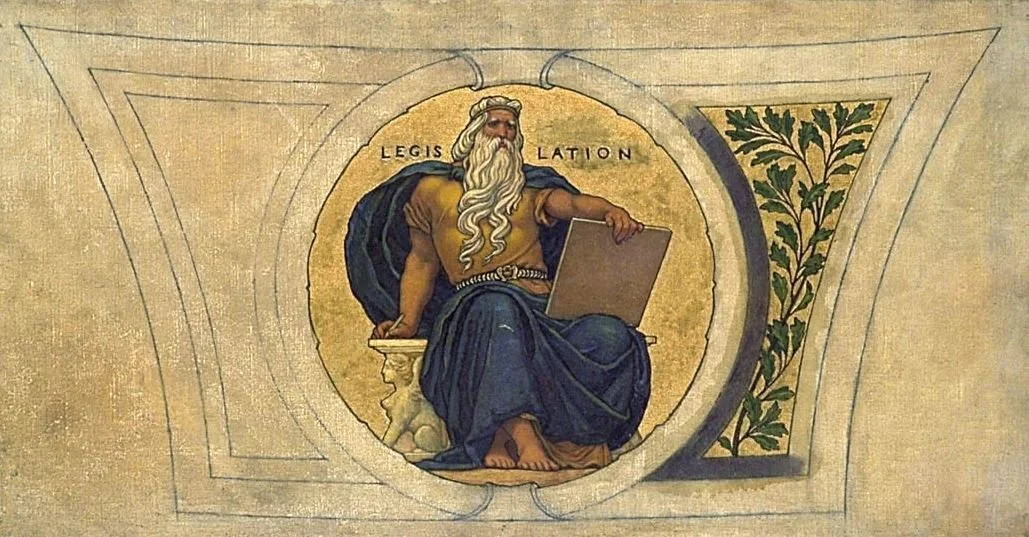
Kenyon Cox – study for Wisconsin State Capitol – 1913
As a member of the national organization, the Institute of Classical Architecture & Art, I was impressed with the words of Mr. Cox above – it was recently reproduced in the annual ICAA publication THE CLASSICIST. Kenyon Cox (1856-1919) was an American painter, writer and teacher. His work is held in the collections of the Metropolitan Museum of Art, the National Gallery of Art, and the Smithsonian American Art Museum. He is the author of several books–including “Old Masters and New” and “Concerning Painting: Considerations Theoretical and Historical”– and criticism appearing in The Nation, Century and Scribner’s magazines. In The Classic Point of View, Cox shares his statement – “of what one painter believes and hopes and fears with regard to painting; of what he takes to be the malady of modern art, and of where he looks for the remedy for it.”
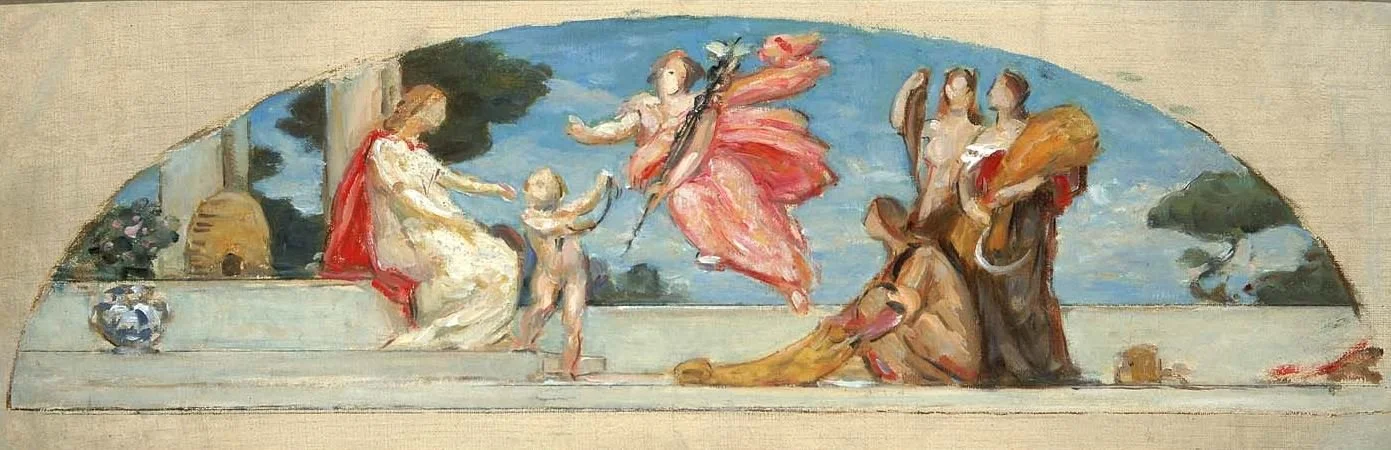
Kenyon Cox – study for bank building “the sources of wealth” – 1903
So according to Mr. Cox, “the classic spirit”, or “the classic point of view”, or perhaps we can simply say “classicism” is analogous with descriptive terms such as:
perfection
clearness
reasonableness
permanence
continuity
fine & noble
beauty & charm, etc.
He suggests that classic beauty is directly linked to the past – i.e. historical precedent. In fact, he uses the analogy of links in a chain…which does not wish to be broken…from tradition or the lovely works of the past. Cox believed that a modern classic can be inventive, original and creative without having to be momentary, violent or blindly emotional. . . as if modern art was a disease to be cured.
But the “modern art” of the early 20th century, to which he refers, is a discussion for another time. And that discussion might include theories of Traditionalism vs. Modernism – reference a recent feature article by Dr. Mark Gelernter “Making room for Traditional Architecture” (see reference link below) wherein a dialogue is initiated toward schools of architecture in the United States. Within this examination, Dr. Gelernter uses “beauty” as an obvious qualifier:
“The world is a richer place for diversity of values, and diversity of architectural expressions. Architects can choose to design Modern or traditional buildings according to the fitness for the design project at hand, not because one is inherently intellectually superior. And both Modern and traditional buildings can be evaluated on an even playing field with the criteria that always have really mattered: do they support their purpose, are they beautiful, affordable and constructible? The value of an individual design should stand or fall on these questions, not on whether it matches a Modernist worldview invented over a century ago to dismiss its rivals. Our new Spirit of the Age demands it.”
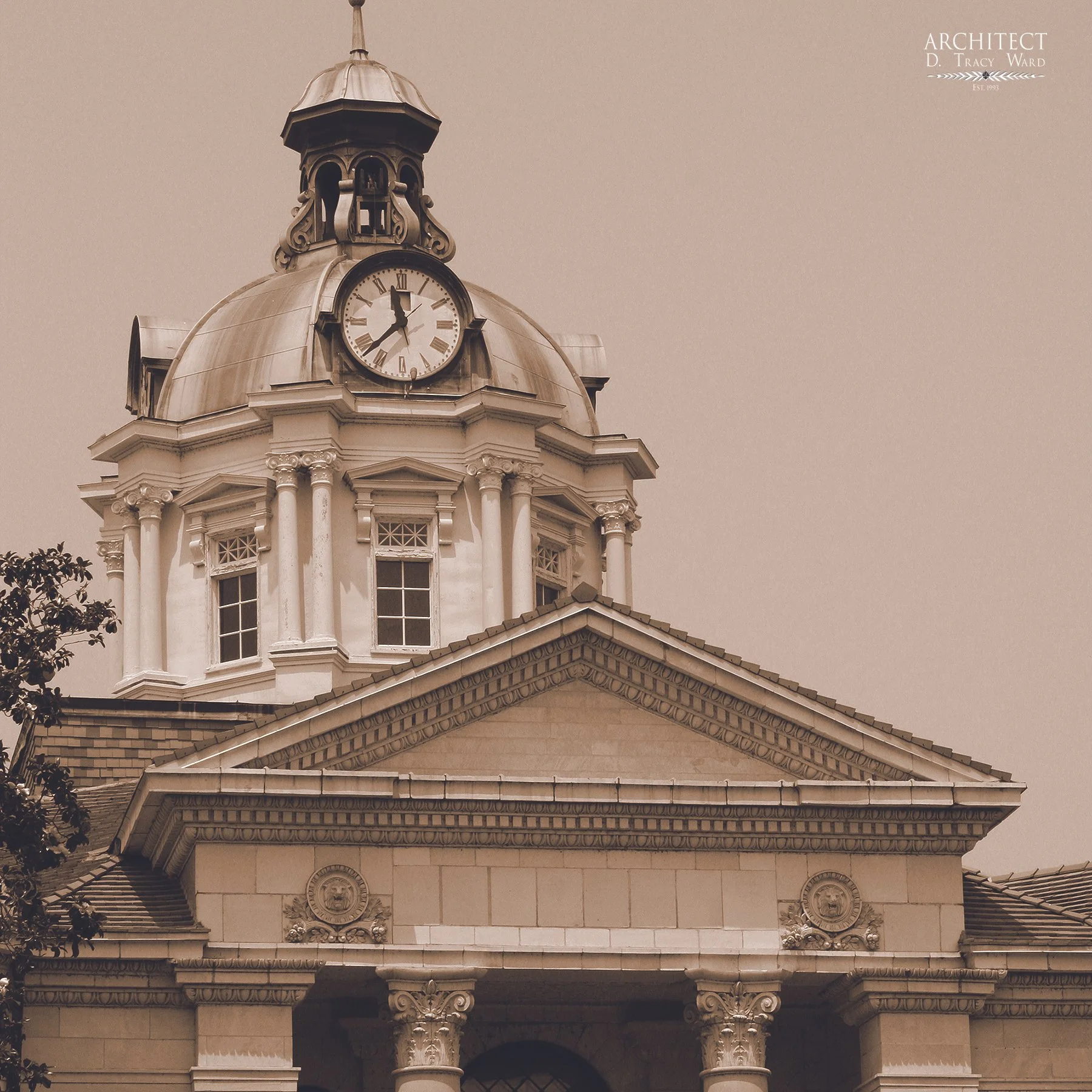
Marion County, Mississippi courthouse – from our book – a noble & lovely example of beauty!
In the new book “Beauty, Neuroscience & Architecture“, Don Ruggles discussed the link between the human brain and our perception of beauty. I encourage you to read and study the book in detail. One repeating visual image he uses is a circle around a triangle encompassing inside the word BEAUTY. The triangle includes the terms Curiosity, Pleasure, and Anticipation – which all together help form our human definition of Beauty. I believe this is further proof the concept of beauty is recognized dependably by all human beings. . . simply because the Almighty Creator designed us and nature thusly.
Legendary architect Renzo Piano — the mind behind such indelible buildings as The Shard in London, the Centre Pompidou in Paris and the new Whitney Museum of Art in New York City — describes architecture as the answer to our dreams, aspirations and desire for beauty. “Universal beauty is one of the few things that can change the world,” he says. “This beauty will save the world. One person at a time, but it will do it.”
In my own architectural practice, we will continue to design buildings and structures with the goal of attaining beauty – beauty that is hopefully appreciated by its community, its guests, and its regular inhabitants. And I pledge to pursue those Godly uplifting characteristics found consistently throughout nature of purity, honesty and truth that provides joy and encouragement for all.
Philippians 4:8 (NIV)
Finally, brothers and sisters, whatever is true, whatever is noble, whatever is right, whatever is pure, whatever is lovely, whatever is admirable—if anything is excellent or praiseworthy—think about such things.
References:
http://americanart.si.edu/collections/search/artist/?id=1026
http://www.classicist.org/publications-and-bookshop/bookshop/
https://www.traditionalbuilding.com/features/making-room-for-traditional-architecture (Mark Gelernter)
Beauty, Neuroscience & Architecture, by Donald H. Ruggles, AIA
D. Tracy Ward, Architect
Originally prepared 2015 – Reedited July 2018 – DTW’s Blog #0024
Our Original Posts, including images when applicable, are copyrighted © 1993-2018 by D. Tracy Ward and Benchmark Design, PC. God bless America! Treasure Liberty always and pass it on! “Architecture aims at Eternity. Architecture has its political Use; publick Buildings being the Ornament of a Country; it establishes a Nation, draws People and Commerce; makes the People love their native Country, which Passion is the Original of all great Actions in a Common-wealth.” [CHRISTOPHER WREN, Parentalia]