Chasing Steeples . . .

Natalee Ward high school competition – Photography 2008 D. Tracy Ward
I have often wondered why a competitive horse race is referred to as a “Steeplechase” while apparently having nothing to do with steeples. Kind of makes you ponder the history of it all. And that’s a lesson for each of us – History is fascinating if you’ll keep asking “why”. What is a steeple? Where did they originate and why? How could anyone possibly “chase” one and for what purpose?
Early American church (religious/ecclesiastical) architecture typically originated from European influence, as did most forms of American architecture. This makes perfect sense in retrospect because most early American pilgrims and pioneers were of European descent and they naturally repeated what was familiar once they made it to the New World. English precedents in particular lead the way, using the guidance and reference of such prominent English architects as James Gibbs and Sir Christopher Wren. 18th century architecture came to be known as “Georgian” because this +/-100 year span was the ruling period of three English Kings – George I, II, and III.
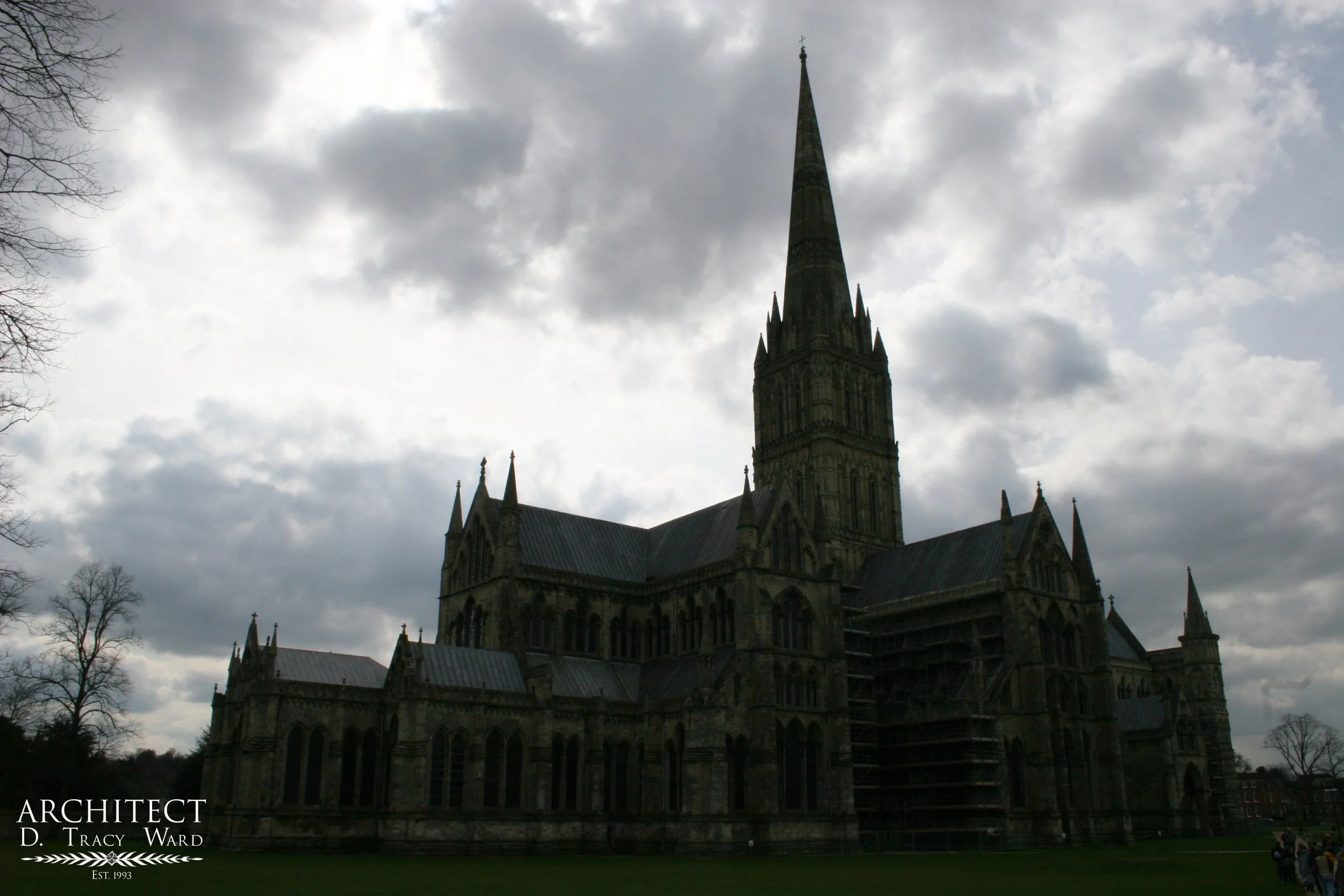
Salisbury Cathedral ca. 1220 – Photography 2006 D. Tracy Ward
Georgian architectural styles eventually evolved into other styles – Gothic, Victorian Gothic, Richardson Romanesque, Colonial, Neo-Classical, Greek Revival, Queen Ann, etc. But regardless of the architectural forms and decorative details, one overriding recognizable element of the church building remained…the steeple. The steeple establishes the church as an important visual focus of the community, and it literally draws the eye upwards to Heaven. But the importance of the church steeple was not limited to visibility. The tall steeple was often used to house a large bell in its “belfry”. Bells were located high in the steeple to scream warning signals or a call to aid in community emergencies, as an announcement for worship hour, to ring the times of day, as a wedding peal, and as a solemn funeral toll.
The Holy Bible defines “sin” as anything that pulls your focus away from God. So what better way to use architectural forms, than to point the community focus upwards to God? This (below) Romanesque Revival First Presbyterian church in Port Gibson, Mississippi exhibits a golden hand on its steeple quite literally pointing up to Heaven – leaving no doubt as to its Christian meaning. Jesus Christ said (John 12:32) “And I, if I am lifted up from the earth, will draw all peoples to Myself.”
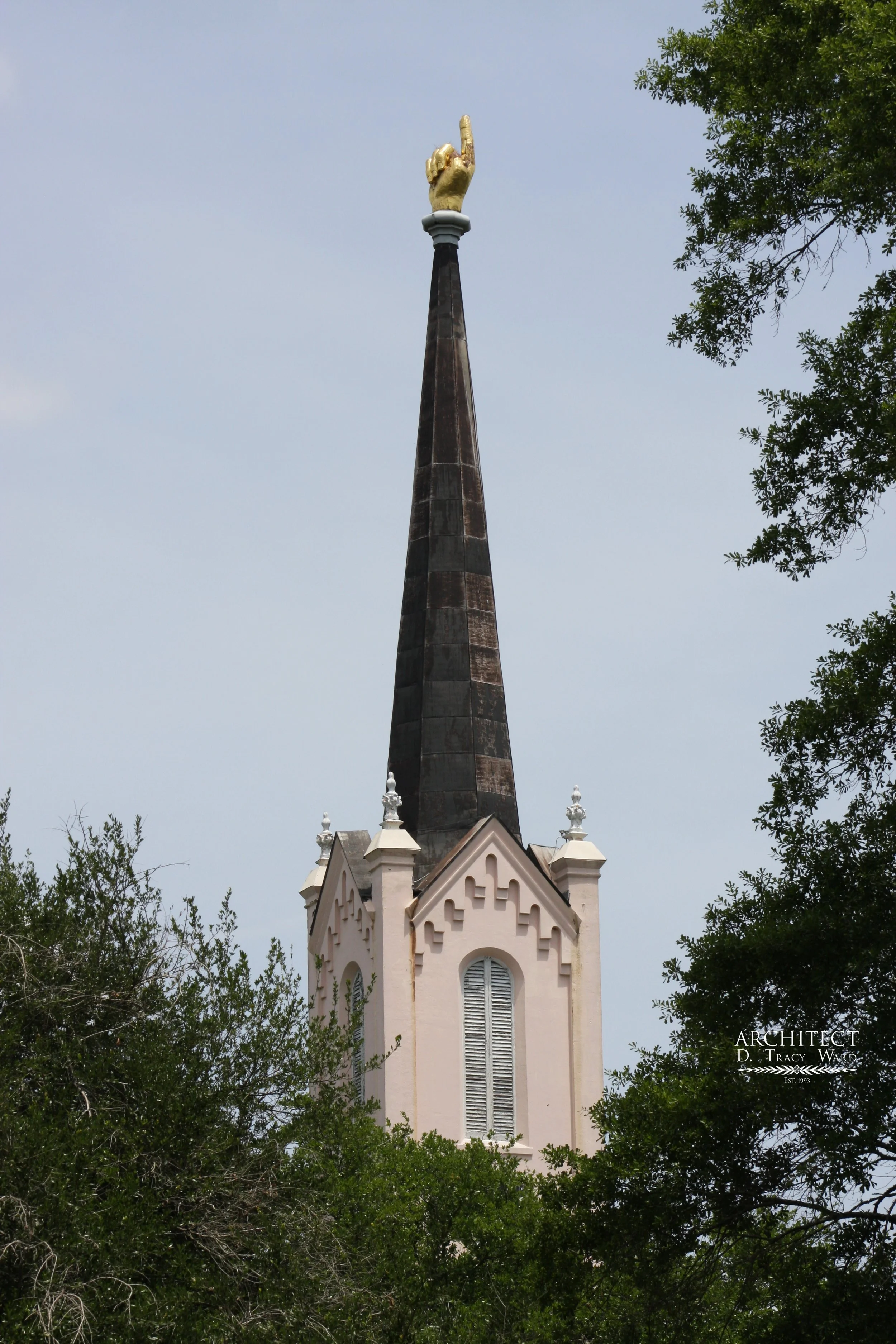
Port Gibson, Mississippi’s golden hand – Photography 2012 D. Tracy Ward
Now we have a basic architectural understanding of a steeple…but what’s it got to do with horse racing? Let’s go back in time again to Europe to find the origins of steeple chasing. The event seems to have evolved from fox hunting and boys racing each other when the hunt got too boring. The most distinguishable landmarks in the rolling hills of the British countryside were the tall church steeples. Race courses spanned from one steeple to the next, usually between two and four miles apart and with various obstacles in between. Horses jumped whatever was in their path – stone walls, fences, hedge rows or streams. Church steeples served at both ends as the start and the finish.
Well, there it is … in-depth historical research tying together the Church and horse racing! That seems laughable, but in actuality, the involvement of the church fully into its community will naturally create ties with all aspects of society … both good and otherwise. And how else is God’s kingdom to “serve” its community but to get right in the middle of it all? I’m sure Jesus would approve if all horse races led us to church and to Him … as the belfry rings aloud as each enters Heaven. Amen!
References:
D. Tracy Ward, Architect
Originally prepared 2015 – Reedited 2018 – DTW’s Blog #0027
Our Original Posts, including images when applicable, are copyrighted © 1993-2018 by D. Tracy Ward and Benchmark Design, PC. God bless America! Treasure Liberty always and pass it on! “Architecture aims at Eternity.” [SIR CHRISTOPHER WREN, Parentalia]